Beyond the Occasion Box: Pearls for Piers, Promenades and Everyday Sparkle
Pearls used to have a reputation problem. Not the pearls themselves, exactly, but the way we were told to wear them: with a certain posture, a certain occasion, a certain amount of formal fuss. Fast forward to 2026 and the picture looks far more relaxed. Pearls are turning up with chunky jumpers, beaten-up denim and raincoats, which feels exactly right for a site built around coastal sparkle. They catch the light like wet shingle, they look good against grey skies, and they do not need a wedding invitation to justify themselves.
The shift from occasionwear to everyday
Part of this is practical. Pearlcore, as the internet insists on calling it, is less about looking rich and more about texture. A freshwater pearl has a soft, slightly irregular surface that sits nicely next to wool, linen and cotton. It is not diamonds. It does not demand a strapless dress. It works with a roll neck.
The other part is generational. Plenty of us inherited a strand from a grandmother or an aunt, wore it once to a christening and then left it in a drawer. Now those strands are being restrung, shortened, mixed with gold chains and worn on ordinary Tuesdays. That feels like progress. Jewellery should earn its keep.
Freshwater versus shell: a plain-English guide
If you are buying new, the two names you will see most often are freshwater pearls and shell pearls. They are not the same thing, and neither is automatically the better choice.
Freshwater pearls are cultured in mussels, usually in China, and they come in a range of shapes, sizes and natural colours. Many are not perfectly round, which is part of their charm. They have a deep, soft lustre and will last for decades if you look after them. They are also more expensive, particularly as the size and roundness increase.
Shell pearls are man-made. They are usually a glass or resin core coated in a pearlescent finish, which means they can be perfectly uniform and very affordable. They are heavier than freshwater pearls in some cases, and they are ideal if you want a bold, oversized look without the price tag. The trade-off is that the coating can wear or flake over time, especially if it is exposed to perfume, hairspray or rough storage.
Neither option is a con. The trick is to know what you are buying and to match it to how you plan to wear it. A delicate freshwater strand for everyday layering makes sense. A big shell pearl necklace for a party outfit also makes sense, as long as you accept it may not be a forever piece.
Layering without the fuss
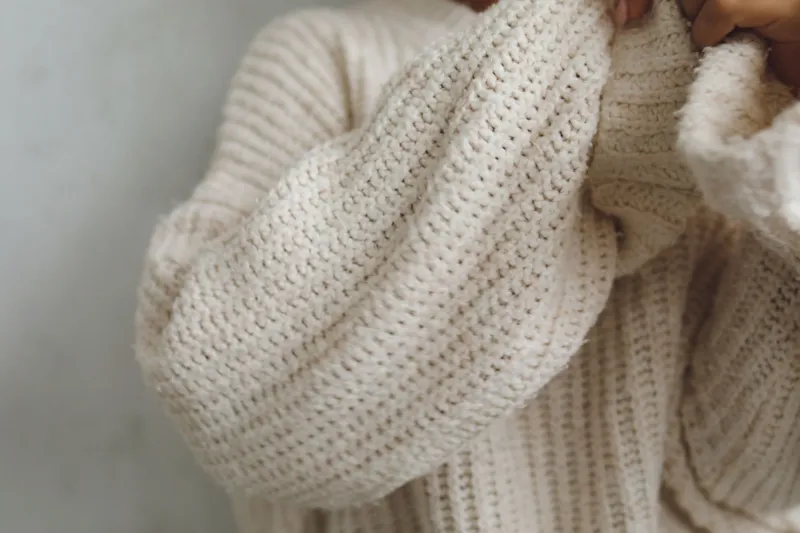
The easiest way to make pearls feel casual is to put them next to something that is definitely not formal. A cream fisherman knit is the obvious place to start. A short freshwater strand sits neatly over the crew neck, or you can go longer and let the pearls peek out below the ribbing. If the knit is chunky, keep the pearls simple. If the knit is fine, you can afford a little more decoration.
Denim is the other reliable partner. A pearl necklace with a plain white tee and a denim jacket is almost a uniform in coastal towns from March to October. In autumn and winter, swap the tee for a grey marl sweatshirt and add a longer strand so it hangs below the hem of the sweatshirt. The contrast between the casual fabric and the pearl is what makes it work.
Mix metals if you like, but give the eye somewhere to rest. One pearl piece plus a thin gold chain is usually enough. Three pearl necklaces, pearl earrings and a pearl bracelet starts to look like a costume. Pick one focal point and let the rest be quiet.
What to look for on the UK high street
The high street has got very good at pearls. Accessorize and Oliver Bonas are reliable for freshwater strands and pearl-drop earrings at sensible prices. M&S and John Lewis often have classic strands in their jewellery halls, particularly in the run-up to Christmas. Independent coastal boutiques are worth checking too, especially in towns with a jewellery-making tradition, because you can often find irregular freshwater pearls set in recycled silver.
If you are buying second-hand, look for silk or cotton thread that is not stretched, a clasp that still clicks firmly, and a knot between each pearl. Restringing is not expensive and can transform an inherited strand into something you actually wear. Charity shops in seaside towns are surprisingly good hunting grounds, partly because people clear out holiday homes and partly because pearls were once such a standard gift.
Keeping pearls luminous through autumn and winter
Pearls are softer than they look. They dislike perfume, hairspray, chlorine and household cleaning products, all of which can dull the surface over time. The rule is simple: perfume first, jewellery last. When you get home, wipe them with a soft dry cloth before putting them away. Do not use alcohol-based cleaners on shell pearls, as the coating can cloud.
Store pearls flat in a soft pouch rather than hanging them, because the thread can stretch. Keep them away from direct heat and radiators, which are everywhere in a British winter. If you are wearing a scarf, put the pearls underneath it rather than on top, so the wool does not rub against the surface all day. And take them off before you swim, shower or do the washing up.
The grey-day styling note
Pearls look especially good against navy, camel and charcoal, which happen to be the colours most of us live in from November onwards. A single pearl pendant on a fine chain, worn with a navy coat and a wool scarf, is understated but not boring. Pearl studs with a chunky cable knit are another easy combination. The point is not to look dressed up. The point is to add a little light to an otherwise ordinary outfit, and to enjoy the fact that you no longer need a special occasion to do it.