When the Coast Claims an Earring: A Field Guide to the One-Earring Aftermath

There is a particular silence that follows the loss of an earring by the sea. It is not quite the silence of the waves, which carry on regardless, but a small, private silence in your own head as your fingers find only an empty lobe. You check the scarf. You check the collar. You look down at the shingle as though it might, this once, give something back.
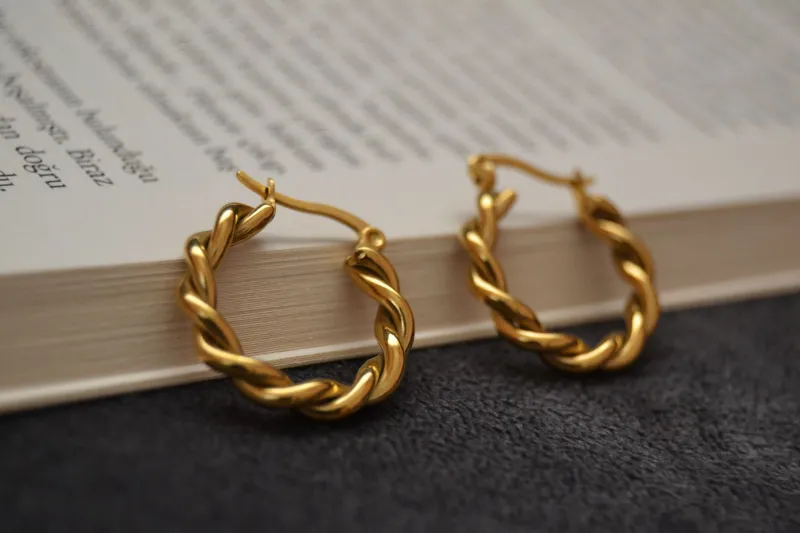
Losing jewellery on the coast is hardly a tragedy in the grand scheme. But the pieces we take to the beach tend to be the ones we love: the small gold hoops from a birthday, the sea-glass studs picked up in a harbour shop, the pair that survived a wedding and a paddle in the same afternoon. Sentiment does not weigh much, but it clings.
So here is a practical, slightly philosophical guide to the moment the coast claims a piece, and to the quieter days that follow.
The First Ten Minutes: Stop, Crouch, and Think Like the Tide
Resist the urge to rake the sand with your foot. Panic scatters evidence, and a foot is a blunt instrument. Instead, stop and mark the spot. A windbreak peg, a stone, a bag placed precisely where you were standing will do. If you were walking, retrace your last twenty or thirty steps slowly and look down rather than ahead.
On sand, earrings do not sink far. They tend to sit on the surface or just beneath a loose scatter of grains, often catching the light at a low angle. Crouch down, put your cheek close to the ground and look across the surface rather than straight at it. A glint is easier to spot sideways. If you have a phone torch, use it flat against the sand; the shadow will often give the metal away before the shine does.
On shingle, the game changes. Pebbles swallow small objects, and a stud can slip between stones with alarming speed. Work in a slow grid, moving a handful of shingle at a time rather than sweeping it about. If the earring had a butterfly back, look for that too, because the back often falls first and marks the general area.
If you were near a beach hut, a café deck or a promenade bench, check the seams. Earrings have a talent for rolling into the gap between boards, under the lip of a step, or into the crease of a folded towel. Ask before you move furniture, and never wedge your hand into a space you cannot see. A waiter with a torch and a dustpan is a better ally than a scraped knuckle.
And if the sea is already there? Then the sea has it. Do not wade after a fallen earring. No piece of jewellery is worth a cold shock or a turned ankle on a falling tide.
Prevention: Small Habits That Keep Pairs Together
The honest truth is that most lost earrings are lost in the same handful of ways: scarves pulled over the head, hats tugged off in a gust, towels used as makeshift pillows, and the eternal optimism of wearing a drop earring on a blustery pier. None of this requires you to dress sensibly. It merely requires a small edit.
- Choose the fastening for the forecast. Butterfly backs are fine for a calm garden; screw-backs, locking backs and huggie hoops are better for wind and wool.
- Put earrings on last and take them off first. Scarves, hats and high collars go on before the earrings and come off after them. It is a tiny sequence that saves a great deal of grief.
- Carry a small pouch, not a pocket. A zip-top pouch in your bag gives a stray earring somewhere to live if you need to remove it mid-walk.
- Pause at the beach hut door. A quick touch of each lobe before you step onto sand is a habit worth building. It takes two seconds and feels faintly ridiculous until the day it works.
The Repurpose Route: One Earring, New Life
A lone earring is not a broken pair. It is a small piece of gold, silver or stone with a story attached, and it can often be given a second role for a fraction of the cost of a replacement.
A jeweller can usually convert a single stud or drop into a pendant by adding a discreet bail or a fine chain loop. A larger statement earring can become a brooch with a pin fitting soldered to the reverse, which is a lovely way to keep a piece close on a coat lapel or a canvas tote. Smaller studs can be turned into charms for a bracelet, particularly if you already have a coastal charm collection with a gap in it. Even a single pearl or sea-glass drop can become a tie pin, a lapel pin or a zip pull for a favourite jacket.
Expect to pay for the work, but far less than a new pair. Ask for a quote before you commit, and be clear about the metal so the new fitting matches. If the earring is plated rather than solid, a good jeweller will tell you honestly whether the conversion is worth it.
The Insurance Question: When It Is Worth the Paperwork
Most home contents policies cover jewellery away from home, but the details matter. There is usually a single-item limit, a claims excess and sometimes a requirement to list valuable pieces separately. Before you ring anyone, find the receipt or valuation, take a photograph of the remaining earring and note where and when the loss happened.
Claiming is rarely worth it for a low-value pair. The excess can swallow the payout, and a claim may affect future premiums. It becomes more sensible for higher-value pieces, for items with a formal valuation, or for a pair where the loss of one earring means replacing both to keep a matching set. If you are unsure, ask the insurer a hypothetical question first. A short phone call costs nothing and tells you whether the numbers stack up.
A Small Ceremony for a Small Loss
In the end, the sea keeps a great many things. It is not personal. The earring that disappeared into the shingle is now part of a shoreline that has been collecting small treasures for centuries. You can mourn it briefly, learn the habit that might prevent the next loss, and then turn your attention back to the things that stayed: the wind, the walk, the friend beside you, the other earring still warm against your neck.
And if you do find it, six months later, at the bottom of a beach bag, tangled in a hair tie and a receipt for an ice cream, then you will have a story worth telling. That, too, is part of the club.